7 min read
THE CLINCH — MUAY THAI'S MOST UNDERRATED WEAPON
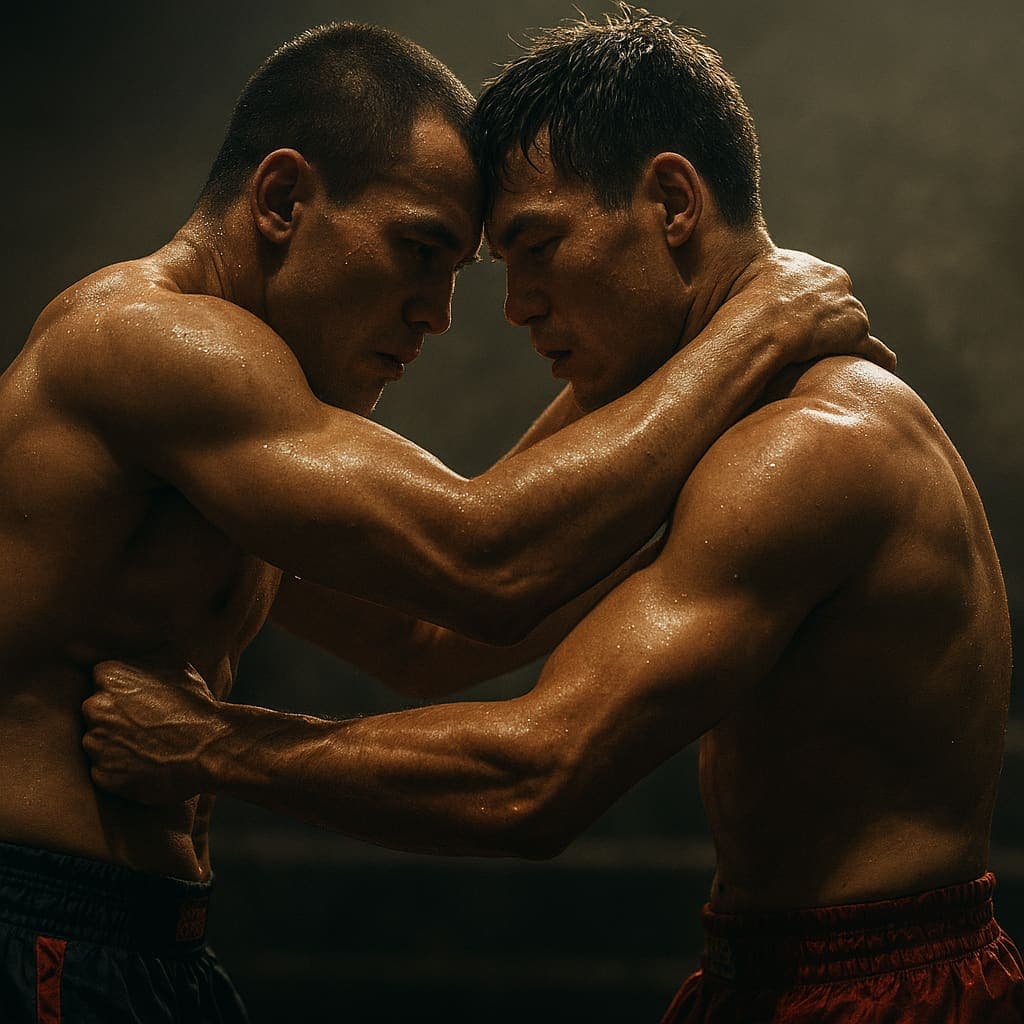
Ask any experienced nak muay what separates Muay Thai from kickboxing and the first answer is almost always the clinch. The clinch is where traditional Muay Thai is won and lost, where the fighter with superior positioning and timing can dominate an opponent even if they are losing the exchanges at range. Yet the clinch is also the most neglected aspect of training for most Western practitioners, who tend to treat it as an afterthought behind punches and kicks.
The fundamental position of the Muay Thai clinch is the double collar tie, known in Thai as pam. Both hands grip the back of the opponent's neck, with the elbows tight together in front of their face, and your forehead pressed against their face or clavicle. From this position, you control their posture, you can step their head down to create openings for knees, and you can turn them to off-balance them for sweeps. Establishing the double collar tie cleanly against a resisting opponent is a skill that takes months of drilling to develop.
Hand fighting is the first battle of the clinch. Before you can establish the collar tie, you have to beat your opponent to the inside hand position. Whoever gets their hands under their opponent's hands has the leverage advantage. This creates a constant push and pull at the start of every clinch exchange, with each fighter trying to pummel their hands inside. Thai fighters drill this endlessly, standing in the clinch with partners and doing nothing but hand fighting for five-minute rounds. The sensitivity and timing you develop through this drilling makes the difference between dominating the clinch and being dominated.
Knees from the clinch are the primary scoring weapon. A straight knee up the middle, landed cleanly to the body or thigh while you control the opponent's head, is one of the highest-scoring techniques in Muay Thai. But throwing knees effectively from the clinch requires good mechanics. You need to pull your opponent's head and shoulders down while driving your hips forward into the knee. If you simply raise your knee without using the collar tie to pull them into it, the strike has half the power it should.
Off-balancing, or jap ko in Thai, is the art of using the clinch to disrupt your opponent's base so they cannot defend or counter. You pull their neck sharply in one direction, step across their hips, or turn your body to rotate them off their center of gravity. A fighter who is constantly off-balance cannot generate power, cannot throw knees effectively, and looks disorganized to the judges. Saenchai is perhaps the modern master of off-balancing, making larger opponents look clumsy through his timing and angles.
Sweeps and dumps are legal in Muay Thai and score points when executed cleanly. Throwing your opponent to the canvas from the clinch, whether through a trip, a hip toss, or a sudden change of direction, demonstrates complete dominance of the exchange. Thai judges reward this heavily. The key to sweeping is using your opponent's momentum against them rather than trying to muscle them down. Wait until they lean or step in a certain direction, then amplify that movement until their base is gone.
Defensive clinching is just as important as offensive clinching. If you find yourself against a stronger clinch fighter, your goal is to break the grip, create space, and disengage cleanly without eating knees. Techniques include framing with the forearm against the opponent's biceps, swimming your arms inside their grip, and stepping your hips back while posting on their collarbone. The ability to defend the clinch safely allows you to engage at range against fighters who would otherwise drag you into their preferred battleground.
Training the clinch requires dedicated rounds with partners, not just incidental contact during sparring. In Thai camps, fighters clinch for twenty to thirty minutes every training session, sometimes more. They rotate partners and work through specific drills before going into live clinching at varying intensities. For Western practitioners whose gyms may not prioritize clinch work, seeking out clinch rounds specifically, even if it means staying after class to drill with a willing partner, is the only way to develop this crucial skill.
How clinch scoring works in traditional Thai judging deserves a closer look. A fighter who establishes a dominant grip — typically a double collar tie or a body lock with one underhook — and lands clean knees from that position scores significantly. A sweep or dump that puts the opponent on the canvas scores even higher. Critically, the fighter who controls the position scores even when no strikes are landing, because Thai scoring treats positional dominance as evidence of the kind of ring control that earns rounds. This is why elite clinch fighters can win rounds through what looks like passive clinching to a Western viewer — the action is actually positional warfare, with subtle hand fighting and grip exchanges that control where the next exchange will happen.
The six positions of the clinch are the technical vocabulary every serious nak muay learns. Inside position with double collar ties is the dominant offensive position. The body lock with one underhook is a secondary control position useful for sweeps. The over-under (one underhook, one overhook) is a neutral exchange position where most clinch fights actually live. The rear waist lock, achieved by spinning behind the opponent, is rare in pure Muay Thai but enabled by some sweeps. Frame defense with one or both forearms on the opponent's biceps creates space and is the primary defensive shape. The escape is technically a non-clinch position but counts as the final stage of any clinch exchange — knowing how to break a dominant grip without taking knees is what separates surviving clinch fighters from dominated ones.
Neck wrestling concepts borrow from Greco-Roman wrestling and Thai tradition equally. The basic principle is that whoever controls the head controls the body — pulling the opponent's head down breaks their posture, exposes their face to knees, and limits their ability to throw their own strikes. The pummel, where both fighters fight for inside position by alternately threading underhooks, is a continuous game during clinch exchanges. Hand fighting at the wrist level — gripping, parrying, peeling — is the layer beneath the visible action that determines who can land knees and who cannot.
The role of the clinch in strategy is broader than just scoring. A fighter who is gassing or hurt can use the clinch to slow the pace, recover, and disrupt their opponent's rhythm. A fighter ahead on the scorecards can clinch defensively to run out the clock. A power puncher who is being out-kicked can close into the clinch to neutralize the kicking range. A defensive fighter can use the clinch as a safe space to avoid a more dangerous striking exchange. Reading these strategic uses in real time turns clinch exchanges from confusing tangles into a clear narrative of who is doing what to whom and why.
The clinch also exhausts opponents in ways that range fighting cannot. Holding a defensive frame while a strong clinch fighter fights for grips burns the upper body and core in a way that punching and kicking does not. Many fights are decided not by the damage done in the clinch but by the cumulative fatigue the clinch produced — a fighter who has been clinched for two rounds is a different fighter in round four than the one who walked into the bout. This is why clinch-heavy styles like muay khao win late-round attrition fights even when they have not done dramatic visible damage.
Why so many international fighters lose to clinch specialists comes down to under-training. Clinch sparring is uncomfortable, sweaty, and unglamorous. It does not produce highlight reels. Most international gyms allocate maybe ten percent of their training time to clinch when fifty percent would be appropriate for the sport's actual technical demands. Foreign fighters who go to Thailand and train in a real Thai camp routinely report that the first month of clinch work is the most physically taxing experience of their fighting careers — and that experience is what builds the structural fitness Thai fighters take for granted.