7 min read
COMMON MUAY THAI INJURIES AND HOW TO PREVENT THEM
Muay Thai is a physically demanding sport that places tremendous stress on the body. From the repetitive impact of kicking to the strain of clinch work, injuries are an inevitable part of training. However, many of the most common injuries are preventable with proper technique, conditioning, and recovery practices. Understanding what can go wrong and how to protect yourself allows you to train harder and longer without unnecessary setbacks.
Shin injuries are perhaps the most iconic Muay Thai ailment. Shin splints, caused by inflammation of the muscles and tendons along the shinbone, are extremely common in beginners who ramp up their kicking volume too quickly. The periosteum, the membrane covering the bone, becomes irritated from repeated impact before the bone has had time to adapt. Prevention starts with gradual progression. Do not go from zero kicks to two hundred heavy bag kicks per session in your first week. Build volume slowly over weeks and months. Shin conditioning happens naturally through consistent, progressive training, not through bizarre methods like rolling bottles on your shins.
Ankle sprains rank among the most frequent Muay Thai injuries. The pivoting motion required for roundhouse kicks, combined with training on mats that can catch the foot, creates ample opportunity for rolled ankles. Strengthening the muscles around the ankle through balance exercises, resistance band work, and proprioceptive training reduces your risk significantly. Ankle wraps or lightweight ankle supports during training provide additional stability, especially if you have a history of sprains.
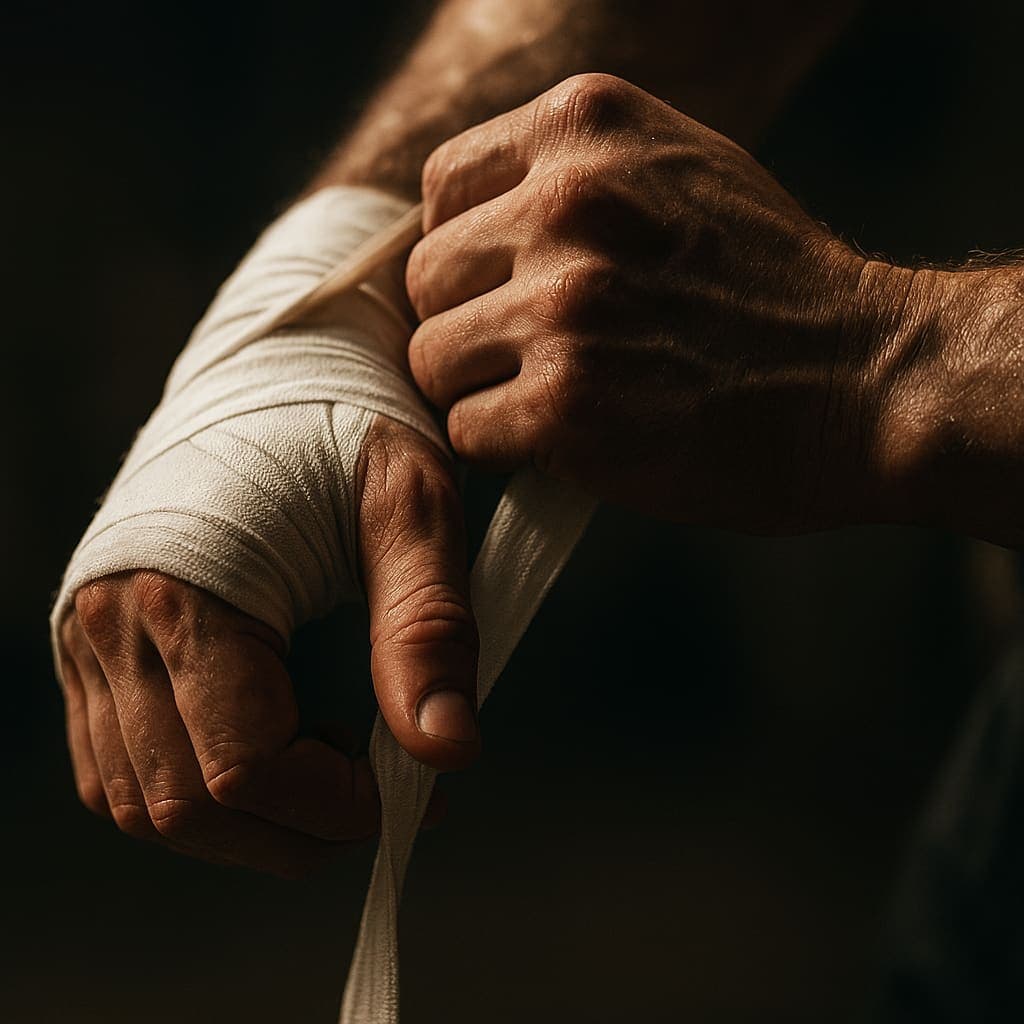
Hand and wrist injuries plague Muay Thai practitioners who neglect proper wrapping technique. The hand contains twenty-seven small bones that are vulnerable to fracture on impact, especially when striking with improper alignment. Always wrap your hands before putting on gloves, using long cotton or semi-elastic wraps that support the wrist and knuckle line. Learn to wrap correctly from your coach rather than guessing. When hitting the heavy bag, focus on proper fist alignment with the first two knuckles making contact. Avoid hitting with the last two knuckles or the base of the fingers, as this dramatically increases the risk of a boxer's fracture.
Knee injuries often develop from the lateral stress of the Muay Thai stance and the torque generated during kicks and clinch work. The medial collateral ligament is particularly vulnerable during aggressive clinch exchanges where the knee can be forced inward. Strengthening the quadriceps, hamstrings, and hip stabilizers through squats, lunges, and single-leg exercises builds a protective framework around the knee joint. Warming up thoroughly before training and avoiding training through sharp knee pain are essential preventive measures.
Rib injuries range from minor bruising to stress fractures and are common during body kick exchanges and clinch knees. While some rib contact is unavoidable, proper defense and body conditioning reduce the severity. Training your ability to brace your core on impact, sometimes called armoring, helps absorb strikes. Strong obliques and transverse abdominis muscles act as natural padding. In sparring, communicate with your partners about intensity, especially if you are recovering from any rib soreness.
Neck injuries develop from the strain of clinch work, where fighters pull and twist each other's heads repeatedly. The cervical spine was not designed for the forces generated in a Muay Thai clinch, and chronic neck problems are common among experienced fighters. Neck strengthening exercises using resistance bands, manual resistance, or a neck harness should be part of every fighter's conditioning routine. In training, avoid excessive cranking on your partner's neck, and take breaks during extended clinch sessions.
Prevention strategies that apply across all injury types include proper warm-up routines that elevate heart rate and prepare joints for impact, adequate rest between training sessions, and listening to your body when something does not feel right. Training through pain is not toughness; it is a shortcut to chronic injury. Ice acute injuries within the first forty-eight hours, use compression where appropriate, and seek professional medical advice for anything that does not improve within a few days.
Recovery practices should be as disciplined as your training. Quality sleep, proper nutrition with adequate protein and anti-inflammatory foods, regular stretching or yoga, and periodic sports massage all contribute to keeping your body resilient. Many professional fighters incorporate cold water immersion and contrast therapy into their recovery protocols. The fighters who have the longest, healthiest careers are not the ones who train the hardest every single day but the ones who train smart and recover thoroughly.
Injury rate data for Muay Thai shows roughly 13-16 injuries per 1000 hours of training based on the published epidemiology from amateur and pro Muay Thai studies, comparable to other contact sports and below American football. The most common injuries are minor (bruises, sprains, lacerations) and resolve within days. Serious injuries — concussions, fractures, ligament tears — make up under 5% of total injuries reported. Understanding the actual numbers calibrates the risk: Muay Thai is not a low-risk activity, but it is not the broken-bones-every-week experience that movies and gyms with ego cultures suggest.
Shin splints, more accurately called medial tibial stress syndrome, deserve specific attention because they are nearly universal in beginners. The condition is inflammation of the periosteum (the membrane around the tibia) and the muscles attaching to the inner shin. It feels like a deep ache along the inside of the shin during and after kicking sessions. Treatment is rest, ice, and gradual reintroduction — not pushing through. The mistake most beginners make is interpreting shin splint pain as conditioning happening, when in fact it is the body warning that the load is exceeding adaptation capacity. Reduce kicking volume, build slower, and the pain resolves; ignore it and you progress to stress reactions and eventually stress fractures.
Ankle sprains are graded I-III based on ligament damage. Grade I is mild stretch with no laxity, return to training in 1-2 weeks. Grade II is partial tear with some laxity, return in 4-6 weeks. Grade III is complete tear and may require surgical repair, with return in 3-6 months. The functional rehab progression is: pain-free range of motion, then strength (resistance band work for ankle stabilizers), then proprioception (single-leg balance, wobble board), then sport-specific movement (lateral steps, pivots), then live training. Skipping rehab phases predicts re-injury.
Shoulder impingement from hook-throwing is a chronic pattern in heavy hook punchers. The mechanism is overuse of the rotator cuff and surrounding muscles in a position that compresses the supraspinatus tendon under the acromion. Symptoms include shoulder pain when raising the arm above 90 degrees and weakness in lateral elevation. Treatment is rotator cuff strengthening (external and internal rotation with bands), thoracic mobility work, and addressing the technical issue — most fighters develop impingement because their hook mechanics rely too much on shoulder elevation rather than hip rotation.
Cauliflower ear, technically auricular hematoma, develops when the cartilage of the ear is repeatedly compressed and bleeds underneath the skin. Without prompt drainage, the blood organizes into scar tissue and creates the permanent deformity. Prevention is wearing headgear during clinch-heavy training. Treatment of an active hematoma requires drainage by a sports physician or experienced trainer within 24-48 hours of formation, followed by compression dressing for 5-7 days. Established cauliflower ear can be surgically corrected but is largely cosmetic at that point.
Concussion protocol in combat sports has evolved substantially. The basic rule: any blow that causes confusion, brief loss of consciousness, or persistent headache requires immediate cessation of training and medical evaluation. Return to training follows a graduated protocol — light aerobic activity, sport-specific exercise, non-contact training, full-contact training — over a minimum of 6 days from full symptom resolution, longer for repeat concussions. Multiple concussions accumulate effects that may not fully reverse, which is why responsible gyms manage sparring intensity carefully and refuse to let students fight when their brains need recovery time. The rule "when in doubt, sit out" is not soft; it is the difference between a long career and chronic neurological symptoms.